
“As much as others may need to change, or we may want them to change, the only person we can continually inspire, prod, and shape, with any degree of success. is the person in the mirror.” ― Kerry Patterson
I was encouraged to read this book in 2024 (I actually listened to it), a long long time after it was published and a long time after I'd graduated. The graduation is relevant because I read Peace Studies (including conflict resolution) at The University of Bradford (back in 2001). What struck me about the book was, how well it educates the reader on what a good conversation looks like. If, after years of study, followed by years of professional communication, someone asked me what the principles of good communication was, my answer would be VERY similar to the key points in this book. My only issue with the ideas in this book is that people won't understand how powerful they are, nor take them seriously enough.
Synopsis
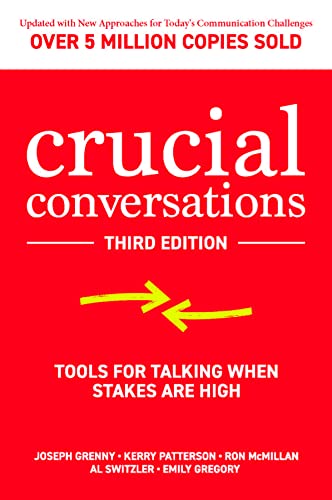
This is a Google Gemini synopsis of Crucial Conversations: Tools for Talking When Stakes Are High by Kerry Patterson, Joseph Grenny, Ron McMillan, and Al Switzler from 2002.
Key Points
Defining Crucial Conversations: A crucial conversation is any discussion between two or more people where the stakes are high, opinions vary, and emotions run strong. These are the moments that significantly impact relationships, careers, and personal well-being.
The Power of Dialogue: The authors emphasise that skilled communicators foster dialogue, which means creating a “Pool of Shared Meaning.” When people feel safe enough to contribute their thoughts, feelings, and experiences, better decisions are made, and commitments are stronger.
Start with Heart: Before a crucial conversation begins, individuals should clarify what they truly want for themselves, for others, and for the relationship. This helps in staying focused on constructive outcomes rather than getting sidetracked by anger or a desire to win.
Learn to Look: It’s vital to notice when a conversation becomes crucial and when safety is at risk. This involves observing both the content of the discussion and the conditions (e.g., body language, tone, silence, or violence) that indicate people are feeling unsafe.
Make It Safe: When safety is compromised, people tend to resort to silence (withholding opinions) or violence (forcing opinions). To restore safety, it’s crucial to establish mutual purpose and mutual respect. This might involve apologising, using “contrasting” statements to clarify intentions, or finding a higher shared goal.
Master My Stories: Our emotions and behaviours are often driven by the “stories” we tell ourselves about events and other people, rather than by the facts themselves. Mastering crucial conversations involves separating facts from assumptions and challenging unhelpful narratives that lead to anger or fear.
STATE My Path and Explore Others’ Paths: When speaking, use the “STATE” model: Share your facts, Tell your story, Ask for others’ paths, Talk tentatively, and Encourage testing. When listening, use “AMPP” skills: Ask, Mirror, Paraphrase, and Prime, to understand others’ perspectives and encourage them to share.
Move to Action: After a crucial conversation, it is essential to translate dialogue into action. This involves deciding who does what by when, clarifying how decisions will be made, and establishing follow-up mechanisms to ensure accountability.
Crucial Conversations: Tools for Talking When Stakes Are High provides a comprehensive framework for navigating difficult and important discussions. The authors argue that success in personal and professional life hinges on the ability to handle these high-stakes interactions effectively. They introduce the concept of a “Pool of Shared Meaning,” suggesting that healthy dialogue occurs when all participants feel safe enough to contribute their perspectives, leading to better decisions and stronger relationships.
The book details a structured approach to crucial conversations, beginning with the individual’s mindset. It encourages readers to “Start with Heart” by clarifying their true intentions and desired outcomes before engaging. Equally important is the ability to “Learn to Look,” noticing the subtle signs that indicate a conversation is becoming difficult or that psychological safety is at risk for any participant. When safety is compromised, the authors provide strategies to “Make It Safe” by re-establishing mutual respect and purpose.
Further, the book delves into managing one’s own emotional responses by learning to “Master My Stories” – recognising how our interpretations of events, rather than the events themselves, shape our feelings and actions. Finally, it offers practical communication tools for both speaking your truth (“STATE My Path”) and genuinely understanding others’ viewpoints (“Explore Others’ Paths”). The ultimate goal is to move from discussion to concrete “Action,” ensuring that agreements are clear, commitments are solid, and accountability is maintained. This systematic approach aims to transform potentially volatile interactions into productive and relationship-building dialogues.
Key Points
- Create safety.
- Stay focused on goals.
- Master emotions.
- Share facts, not accusations.
- Explore others’ views.