
“There is a time in a boy’s life when the sweetness is pounded out of him; and tenderness, and the ability to show what he feels, is gone.” - Norah Vincent
This book was published in 2007, almost twenty years before governments and journalists were up in arms about what it meant to be a woman. At the time, the content resonated with me and still does. After reading this (or if you're a man being honest with yourself) it's clear to see that the violence, aggression and emotional-suppression we call masculinity is as damaging and unwelcome to the men that behave that way as it is to the people (mostly women) who are on the receiving end. As hard as it is to imagine and as reluctant as we may be to give it, I think this book shows that sympathy and kindness (rather than yet another firm hand) is what men need to change their behaviour for the better.
Synopsis
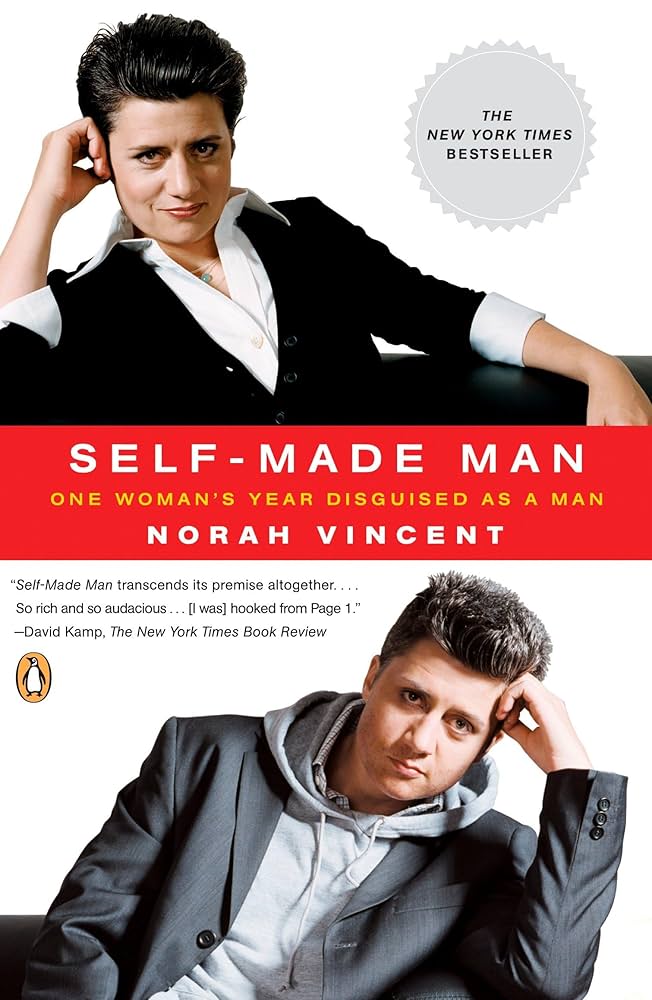
In this insightful book, Norah Vincent, a journalist, embarks on an extraordinary experiment: she disguises herself as a man, “Ned,” for eighteen months to experience life from a male perspective. With a buzz cut, a flattened chest, fake stubble, and a deepened voice, Vincent immerses herself in typically male environments. Her journey takes her to a bowling league, a high-pressure sales job, dating scenes with women (and some men), strip clubs, a men’s therapy group, and even a monastery. The goal is to understand the nuances of male friendships, the pressures men face, and how they navigate the world without the presence of women.
Vincent’s experiences as Ned are eye-opening. She discovers that while men may enjoy certain privileges, they also grapple with immense burdens and expectations. She observes the codes of conduct among men, the unspoken rules of male intimacy, and the difficulty many men have in expressing emotions. The book highlights the relentless pressure to be strong, stoic, and successful, and the often isolated nature of male existence. Vincent finds that the “male privilege” often discussed can come with a heavy cost, including emotional repression and a constant need to prove oneself.
Ultimately, Vincent’s journey as Ned profoundly changes her understanding of both men and women. She gains a deep empathy for the male condition, realizing that men suffer in their own unique ways and face significant challenges. The experiment is not without its personal toll; the mental strain of maintaining a false identity and confronting the realities of male life eventually leads to a depressive breakdown for Vincent. “Self-Made Man” is a thought-provoking exploration of gender roles, identity, and the surprising complexities of what it means to be a man in contemporary society.
Key Points
1. Gender roles are performative.
2. Male privilege is complex.
3. Men face emotional suppression.
4. Society enforces conformity.
5. Empathy bridges experience.