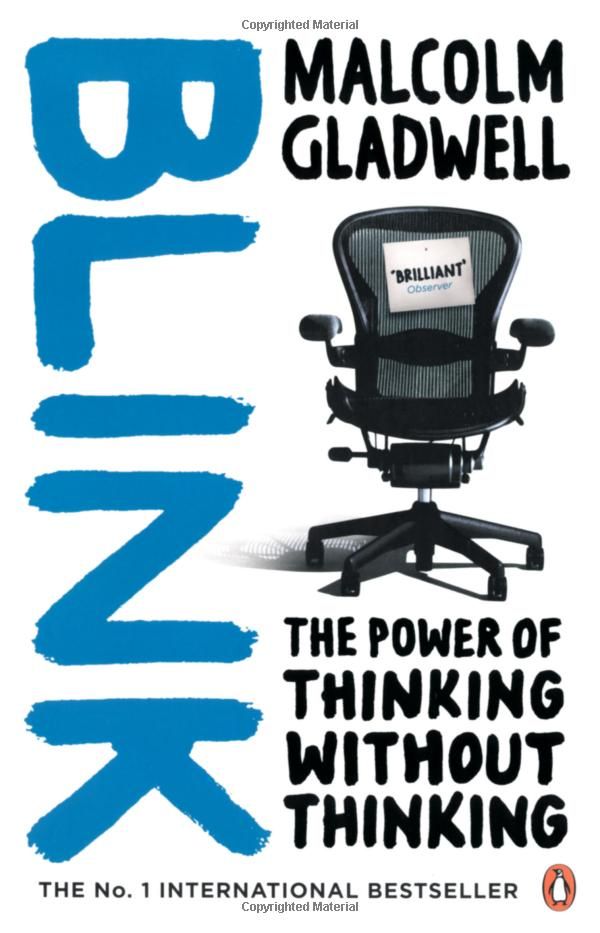
This book helps you to see that all the decisions you make are primed and biased.
Blink is another book by Malcom Gladwell but this time he looks at how we all make decisions and judgement calls in a blink of an eye. Whilst the book advertises itself as "thinking without thinking" I think the best take away from this book is, (like Influence) helping you to understand all of the other factors at play when a person makes a decision.
Malcolm Gladwell is an interesting writing with plenty of anecdotes and interesting back-story to keep these books interesting. That said, it can sometimes feel like it’s taking a long time to get to the point.
I recommend this book because it’s really a book about the ideas of priming and bias. Both principles boil down to …
However rationale you think you are, everything that happens before and in the moment will affect your decision.
I take two things away from this:
Firstly that I know my thought-process is not completely my own. Everything I have interacted with, especially the things I repeat, creates a magnetic force that pull my thoughts in a particular direction.
Secondly, that no matter how ‘stubborn’ people are they can be influenced.
Ah, “Blink”! That’s a fascinating deep dive into how our minds work, isn’t it? Malcolm Gladwell challenges our conventional wisdom about decision-making.
Here’s a summary of the key ideas from “Blink”:
- Snap judgments are powerful: Decisions made in a “blink” can be as good, or even better, than those made with extensive analysis.
- “Thin-slicing” is key: Our unconscious mind can filter out irrelevant information to quickly grasp the essence of a situation.
- The adaptive unconscious: A powerful, automatic part of our mind processes vast amounts of data in an instant.
- Experts excel at thin-slicing: Experience and practice hone this intuitive ability in professionals.
- Intuition is not magic: It’s a product of learned patterns and deep knowledge, often operating below conscious awareness.
- Biases can distort snap judgments: Our unconscious associations, including stereotypes, can lead us astray.
- Too much information can be detrimental: Over-analysis, or “analysis paralysis,” can hinder effective decision-making.
- Context matters: The environment and circumstances significantly influence our rapid cognitions.
- We can train our intuition: Through exposure and mindful reflection, we can improve our snap judgments.
- Respect the “locked room”: Sometimes, we know things without being able to explain precisely why, and that’s okay.
- Verbal overshadowing: Trying to explain an intuitive decision can sometimes undermine its accuracy.
- Stress impairs judgment: High-pressure situations can make our rapid cognition less reliable.